
How you connect multiple LiFePO4 batteries decides your system voltage and capacity. Get it wrong and you can damage the pack — get it right and you build exactly the system you need. Here is the plain-English version.
Series
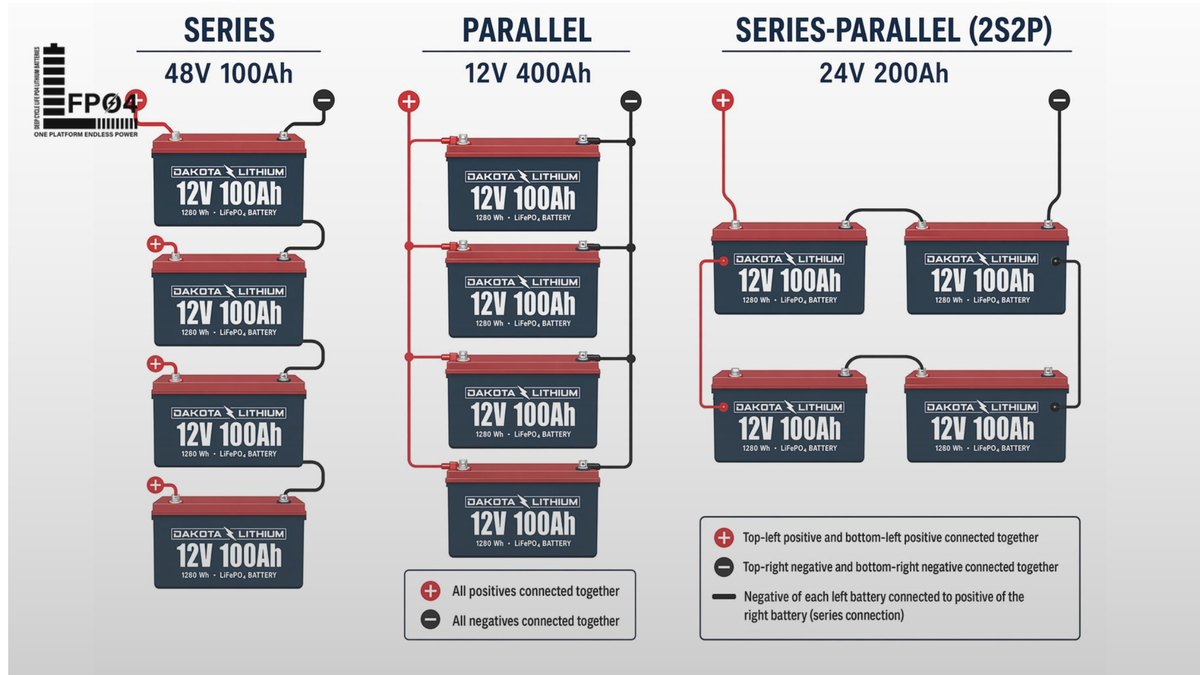
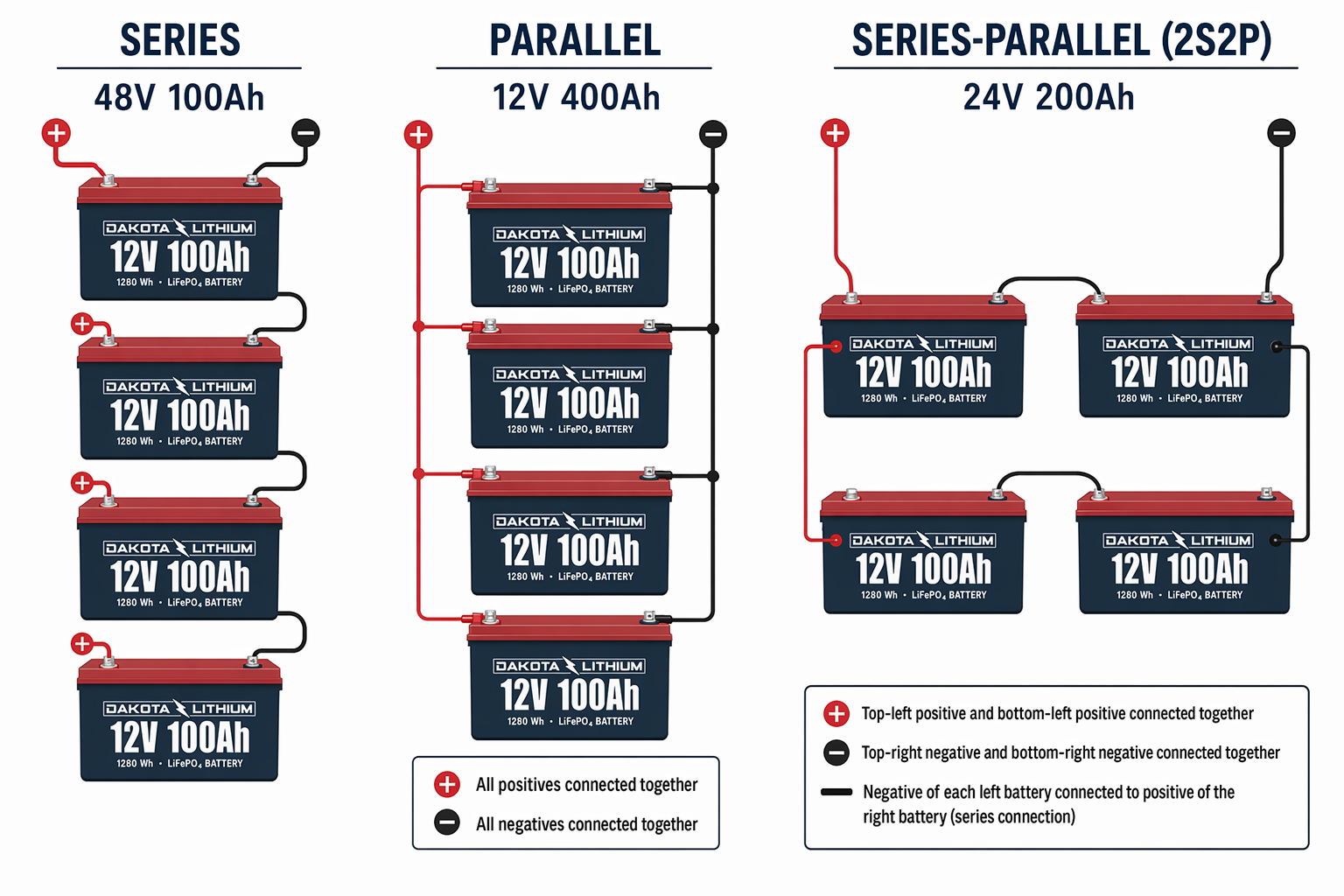
Voltage adds up. Capacity stays the same.
Connect positive of one battery to negative of the next (+ to −). Two 12V 100Ah batteries in series become a 24V 100Ah bank. Use this to reach 24V, 36V, or 48V systems for golf carts, trolling motors, and inverters that need higher voltage.
Example: 2 × 12V 100Ah = 24V · 100Ah
Parallel
Capacity adds up. Voltage stays the same.
Connect all positives together and all negatives together (+ to +, − to −). Two 12V 100Ah batteries in parallel become a 12V 200Ah bank — more runtime at the same voltage. Ideal for RV house banks and off-grid storage.
Example: 2 × 12V 100Ah = 12V · 200Ah
Series-Parallel
Raise voltage AND capacity.
Wire pairs in series, then join those strings in parallel. Four 12V 100Ah batteries become a 24V 200Ah bank — the foundation of larger off-grid and marine systems that need both higher voltage and long runtime.
Example: 4 × 12V 100Ah = 24V · 200Ah
Quick reference
| Goal | Wiring | Result |
|---|---|---|
| More voltage (24V / 36V / 48V) | Series (+ to −) | Voltage adds, capacity unchanged |
| More runtime (same voltage) | Parallel (+ to +, − to −) | Capacity adds, voltage unchanged |
| Both | Series-parallel | Voltage and capacity both increase |
Before you wire — 4 safety rules
- Only combine identical batteries — same brand, voltage, capacity, and age. Mixing damages the weaker pack.
- Charge each battery to the same voltage before connecting them in parallel for the first time.
- Use a correctly sized fuse or breaker on every battery bank, and cable rated for your full current.
- Confirm your charger and inverter match the final bank voltage (a 12V charger cannot charge a 24V series bank).

Share:
Can I Use LiFePO4 with Solar Panels and Inverters? Compatibility Guide
The Complete Guide to LiFePO4 Batteries for RVs and Vans